
Recap: Trump v. Barbara
Brief recap on the Trump v Barbara Supreme Court case that was heard on Wednesday, April 1st.

Last Wednesday, April 1st, the Supreme Court heard oral arguments for a monumental case that could change the citizenship of the United States in Trump v. Barbara. On his first day in office, President Trump signed Executive Order 14160, titled “Protecting the Meaning and Value of American Citizenship,” which would effectively end a century-old interpretation of the 14th Amendment. With the exception of children of diplomats and certain territories, if you are born on U.S. soil, you are a U.S. citizen. Currently, enforcement of the EO has been stalled as lawsuits move through the courts and reach the Supreme Court. Nonetheless, the language of the Birthright Citizenship Clause in the 14th Amendment is very clear:
“All persons born or naturalized in the United States, and subject to the jurisdiction thereof, are citizens of the United States and of the State wherein they reside.”
The Trump administration seeks to have the Court re-interpret the meaning of “subject to the jurisdiction thereof,”. The language of the amendment would not change, not even a comma will be added, but the meaning of the words would be understood differently. Re-interpreting the Clause will not only make all newborns presumed noncitizens, but will also require every parent to prove their status or citizenship for the child to be a U.S. citizen, and will open the door for the citizenship of current citizens to be challenged or scrutinized.
Advocates for ending Birthright Citizenship have attempted to frame their attack on the constitutional right as wanting to “restore” it to its original meaning, and that children of undocumented people and those on temporary visas were not intended to become citizens. Framers of the 14th Amendment fully recognized and intended for the clause to not only apply to former slaves. However, as a result of the amendment, a nation of people has been born who the framers of the Constitution never intended to be citizens. The white supremacist roots of the country cannot be diminished, or else you will not grasp the full picture.
Through years of colonial violence, the United States has already created tiered systems as it relates to United States citizenship. For example, there are Americans who are 14th Amendment citizens, and then there are Americans who are statute citizens. Statute citizens are people who received their citizenship through Congressional legislation, such as those from the colonies, including Puerto Rico, Guam, and the Mariana Islands. Since these Americans are not 14th Amendment Citizens, Trump v Barbara will have minimal impact. Unfortunately, Americans from the colonies are already in a much more precarious position than 14th Amendment citizens who might be grappling with this case. Since Americans from the colonies received their citizenship through Congress, they can also be stripped of it at any time by Congress. The reason U.S. colonies are in this precarious position is that federal officials did not want to extend citizenship to races they thought to be “inferior.” If you do not reckon with the white supremacist origins of the country, political events will not make sense to you.
Oral Arguments & Counting to Five
The recording of last week’s oral argument can be found on CSPAN. There were a number of issues discussed during debates, including Dred Scott, Tribal sovereignty, changes to citizenship by Congress, the potential for retroactive application, domicile, and allegiance. Kavanaugh was the first to ask and acknowledge that the government ultimately seeks constitutional relief, meaning the Trump administration is seeking to have the 14th Amendment constitutionally reinterpreted.
The stakes for the future of Birthright Citizenship in the United States are high, and the justices knew it. Media outlets report that justices do not seem persuaded by General Sauer’s arguments. However, critical questions should not be seen as dismissive; the justices were also critical of ACLU Director Cecillia Wang. SCOTUSblog columnist Adam Feldman’s empirical analysis shows Justices Jackson, Gorsuch, and Sotomayor focused more on Sauer, while Barrett, Kavanaugh, Sotomayor, and Alito focused on Wang.
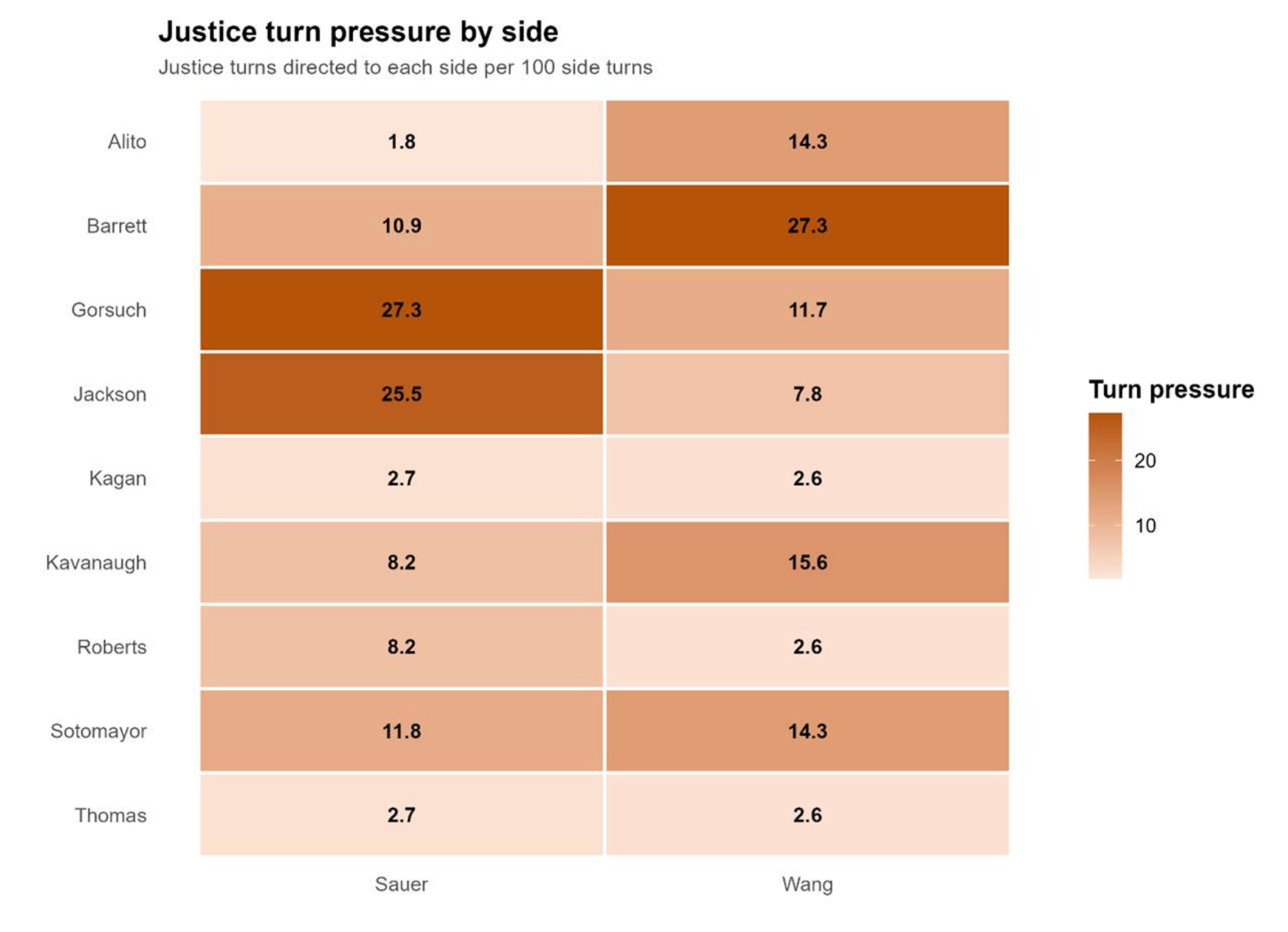
Justice Gorsuch questioned General Sauer on how the government’s new test would apply to Tribal Indians and whether they are citizens under the 14th Amendment’s birthright citizenship. General Sauer answered yes, which may have been the nail in the coffin for Gorsuch, who, despite other beliefs, consistently favors Tribal sovereignty and upholds treaties. The reader should note that citizenship for Tribal Indians was not expanded until 1924, by Congressional legislation.
Justice Gorsuch may have wanted an answer that does not conflict with our understanding of Tribal sovereignty and their citizenship. Gorsuch also posed the same question to Wang, to which she replied, “No.” Wang, who is challenging the EO, made arguments to preserve the interpretation of the citizenship clause that was decided in the 1898 case Wong Kim Ark. Feldman believes the pressure data gathered is consistent with a “7-2 or 6-3 outcome favoring the challengers – with Thomas and Alito as the most probable dissents, and Barrett as the swing justice.” Although they posed critical questions, we should not discount how either Kavanaugh or Gorsuch might lay their rationale for upholding the EO. That said, Thomas, Alito, and Barrett are the most likely to vote to uphold the EO.
Consequences
We must think about how policy changes are implemented in practice. In application, if we are no longer granting automatic citizenship to babies of undocumented people or on temporary visas, then all babies will be presumed noncitizens until their parents’ status can be confirmed. Many observers and advocates for the EO believe it will only impact the children of people on temporary visas, undocumented people, or “birth tourists,” but they are wrong. The only way to know whether Baby A was born to a US citizen and thus eligible to become a citizen, versus Baby B, is for the parents to prove it. If this EO goes into effect, new parents will have to prove their citizenship or status before their newborn can be deemed a U.S. citizen. Guidelines issued by the Social Security Administration state that applicants may currently use a birth certificate to prove citizenship, but once the EO goes into effect, it will no longer be sufficient. While speaking with Justice Jackson, General Sauer emphasized that SSNs can and will continue to be issued because they do not prove citizenship, since noncitizens on work visas can obtain them as well.
Many US citizens right now do not have documents that would otherwise prove their citizenship prior to the case and EO. A survey conducted by the Brennan Center for Justice found that at least 21.3 million Americans do not have ready access to documents that would prove their citizenship, such as a birth certificate, U.S. passport, naturalization certificate, or citizenship certificate. The issue is even more concerning, as the survey also found that 3.8 million Americans do not have these documents and thus would not be able to prove their citizenship, despite being American citizens. What would happen to the children of these 3.8 million people who do not have proof of citizenship? Under the EO, the children would not receive citizenship if neither parent can prove their status.
In addition to changes to how citizenship is proven, we may see the EO applied retroactively, meaning people born before the Order may be stripped of their citizenship if they cannot prove their parents’ citizenship status at the time of their birth. The EO does not state that it cannot be applied retroactively. In fact, concerns about the retroactive application of the EO were discussed not only in oral arguments but also during the Senate Judiciary Subcommittee on the Constitution hearing on March 10th. Even if the government is being honest about wanting a prospective decision, the position it is taking still leaves open the possibility that Congress could move forward with retroactive application via legislation. In addition, we cannot de-couple this from the administration’s pursuit to denaturalize Americans. Naturalized citizens are people who were not born in the United States, but became citizens later in life.
What’s Next?
The Court will not release its decision on the case till June or early July. Justices could strike down Trump’s EO entirely, uphold it, or even carve another decision out of it. Nonetheless, the time to prepare is now, well before a decision. Begin requesting these important documents from your birth state’s agencies and get your documents together. Start a file that holds your or your household’s important documents, such as SSN, birth certificate, passports, adoption papers, marriage contracts, name change documents, etc. If you think you may need to travel internationally, consider getting some of your documents apostilled, which will add an international stamp of approval and further legitimize them for the future.